MATH-500 accuracy recovered on Qwen2.5-Math-1.5B when a mismatched chat template is used, with a 20-token prefix RSP.
NeurIPS 2026
From Noise to Diversity
Random Embedding Injection in LLM Reasoning
1 Gwangju Institute of Science and Technology (GIST) · 2 Seoul National University
* Equal contribution · † Corresponding authors
Append a few random vectors to the prompt. No training, no learned content. The model explores more reasoning paths early and still commits to one answer.
Random Soft Prompts
Soft-prompt methods improve reasoning by inserting trained vectors into the input, but whether the gain comes from the learned content or from the act of injection has not been separated. We study the simplest possible soft prompt: a Random Soft Prompt (RSP) drops the training step and appends a freshly drawn sequence of random embedding vectors to the input.
Each vector is sampled from an isotropic Gaussian fitted to the entrywise mean and variance of the pretrained embedding table, so it has the scale of a real token but no preferred direction. The sequence carries no learned content, yet it reaches accuracy comparable to optimized soft prompts (TTSV[1], SoftCoT[2], LTPO[3]) on MATH-500, GSM8K, and AIME24.
hj ~ N(μE·1, σE2·I), j = 1 … L, input = [X ; H]
| Model | Benchmark | Baseline | RSP (suffix) | TTSV | SoftCoT | LTPO |
|---|---|---|---|---|---|---|
| Qwen2.5-Math-7B-Instruct | MATH-500 | 83.20 | 83.52±0.56 | 83.44±0.55 | 82.88±0.32 | 82.64±0.43 |
| GSM8K | 95.45 | 95.60±0.08 | 95.12±0.11 | 94.74±0.28 | 94.97±0.11 | |
| AIME24 | 13.33 | 16.67±0.00 | 15.32±4.11 | 18.00±2.67 | 12.67±1.33 | |
| Qwen2.5-Math-1.5B-Instruct | MATH-500 | 73.00 | 74.12±1.36 | 72.32±1.75 | 72.88±2.27 | 73.68±0.97 |
| GSM8K | 85.29 | 84.99±0.22 | 84.04±1.07 | 82.97±2.97 | 84.76±0.52 | |
| AIME24 | 10.00 | 13.33±5.27 | 6.02±1.22 | 9.33±2.42 | 9.33±1.33 |
The same holds across injection positions and model families. Where the baseline is already strong, suffix RSP matches it. On the harder AIME24 it adds a few points. When a base model is evaluated with a chat template it was never trained on, a random prompt recovers much of the lost accuracy.
| Model | MATH-500 | GSM8K | AIME24 | ||||||
|---|---|---|---|---|---|---|---|---|---|
| Baseline | RSP (prefix) | RSP (suffix) | Baseline | RSP (prefix) | RSP (suffix) | Baseline | RSP (prefix) | RSP (suffix) | |
| Instruct models | |||||||||
| LLaMA-3.1-8B-Instruct | 52.20 | 41.24±2.16 | 49.52±1.48 | 85.75 | 76.30±0.75 | 86.70±0.39 | 6.67 | 3.33±2.36 | 6.67±3.33 |
| Qwen2.5-Math-7B-Instruct | 83.20 | 81.72±0.46 | 83.52±0.56 | 95.45 | 94.92±0.28 | 95.60±0.08 | 13.33 | 13.33±2.36 | 16.67±0.00 |
| Qwen2.5-Math-1.5B-Instruct | 73.00 | 75.60±0.51 | 74.12±1.36 | 85.29 | 85.26±0.39 | 84.99±0.22 | 10.00 | 12.00±1.83 | 13.33±5.27 |
| Base models + ChatML (format mismatch) | |||||||||
| Qwen2.5-Math-7B | 52.20 | 57.40±1.71 | 69.40±1.03 | 58.30 | 56.25±1.14 | 75.88±0.36 | 23.33 | 9.33±4.35 | 20.00±2.36 |
| Qwen2.5-Math-1.5B | 34.40 | 61.56±1.42 | 48.80±2.09 | 37.45 | 66.07±1.03 | 50.24±2.09 | 13.33 | 14.67±2.98 | 8.00±5.06 |
Content or injection? Replace the trained vectors and see.
We keep each method's injection length and position fixed and only change what is injected. Replacing all trained vectors with random draws does not consistently hurt. Shuffling token order or permuting coordinates inside each vector, which destroys the learned structure but keeps the norms, does not hurt either. The channel is not inert: overtraining the same vectors with a 1000× learning rate collapses accuracy.
| Intervention | TTSV[1] | LTPO[3] | SoftCoT[2] | ||||||
|---|---|---|---|---|---|---|---|---|---|
| MATH-500 | GSM8K | AIME24 | MATH-500 | GSM8K | AIME24 | MATH-500 | GSM8K | AIME24 | |
| Trained | 72.33±1.46 | 84.08±1.08 | 6.67±0.00 | 74.07±0.82 | 84.69±0.21 | 7.78±1.57 | 72.87±1.18 | 84.84±1.24 | 8.89±1.57 |
| 50% front | 75.40±0.28 | 84.99±0.70 | 10.00±0.00 | 74.27±0.47 | 84.63±0.34 | 10.00±2.72 | 72.47±0.98 | 84.15±1.29 | 10.00±2.72 |
| 50% random | 72.93±1.95 | 81.07±3.54 | 12.22±1.57 | 73.87±0.90 | 84.91±0.39 | 8.89±1.57 | 73.33±0.25 | 84.53±0.32 | 12.22±1.57 |
| 100% RSP | 75.13±0.25 | 85.09±0.44 | 11.11±1.57 | 73.80±0.91 | 85.06±0.57 | 11.11±1.57 | 73.67±0.52 | 85.01±0.19 | 8.89±1.57 |
| Token-shuffle | 72.40±0.99 | 83.83±0.38 | 6.67±2.72 | 73.60±0.49 | 84.61±0.06 | 7.78±1.57 | 72.80±1.56 | 84.96±0.29 | 11.11±1.57 |
| Dim-permute | 71.93±0.57 | 83.62±0.55 | 5.56±1.57 | 74.00±0.43 | 84.00±0.77 | 12.22±1.57 | 74.80±0.16 | 84.99±0.16 | 13.33±0.00 |
Branch early, anneal later.
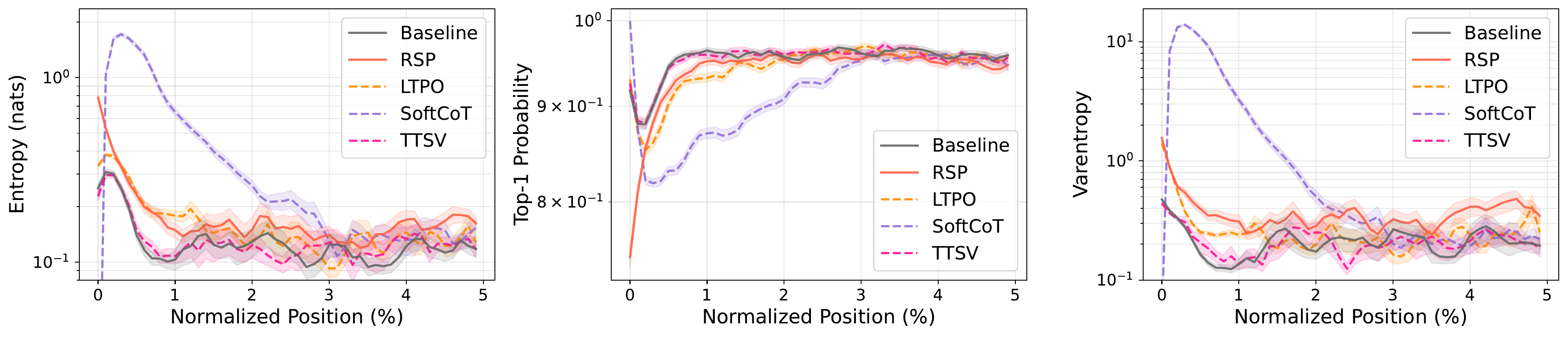
RSP flattens the distribution over the first few generated tokens: entropy and varentropy go up, top-1 probability goes down, and the curves return to the baseline within a few percent of the generation. Optimized soft prompts show the same early pattern despite different training objectives.
The mechanism is attention mass. With a fixed number of RSP tokens and a growing KV cache, the share of attention on the random positions shrinks as generation proceeds, so the perturbation that opened a new branch fades and the response commits to a single completion.
Diversity that turns into Pass@N.
Temperature rescales the same distribution and never changes the ranking of tokens. RSP reranks: the Spearman correlation with the baseline first-token distribution is 0.71 instead of 1.0. Matching RSP's distributional shift with temperature alone (τ = 3.0) drops accuracy to 1.4%, while RSP keeps 73.3%.
Drawing a fresh RSP for every sample and combining it with temperature sampling gives the highest Pass@N on both MATH-500 and AIME24. Sharing one RSP across samples gives no gain, so the benefit comes from varying the perturbation, not from any single one.
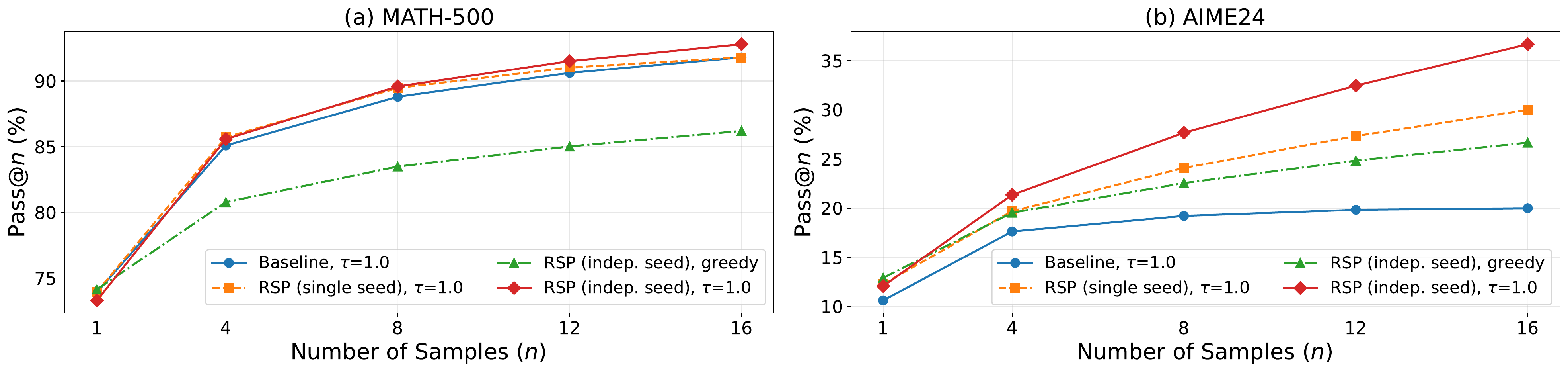
Pass@16 on AIME24 with an independent RSP per sample, versus roughly 20% for temperature sampling alone.
Spearman correlation between RSP and baseline first-token rankings. Temperature keeps it at exactly 1.0.
Beyond inference: better training data.
If RSP finds correct solutions that plain sampling misses, it should help rejection-sampling fine-tuning. On 32,737 hard problems that Qwen2.5-Math-7B-Instruct solves at most once in four clean rollouts, we draw eight rollouts per problem with and without RSP, keep the correct ones, fine-tune the same model on each set, and evaluate without RSP.
| Collection | Problem coverage (%) | Rollout accuracy (%) | Accuracy after SFT, 5-benchmark avg. (%) |
|---|---|---|---|
| No SFT | – | – | 40.26 |
| Baseline sampling | 23.75±0.10 | 5.54±0.03 | 42.11±0.54 |
| RSP | 49.68±0.13 | 17.45±0.05 | 43.77±0.54 |
Citation
@inproceedings{kim2026rsp,
  title     = {From Noise to Diversity: Random Embedding Injection in LLM Reasoning},
  author    = {Kim, Heejun and Lee, Seungpil and Yeom, Jewon and Sok, Jaewon and
               Park, Seonghyeon and Park, Jeongjae and Kim, Taesup and Kim, Sundong},
  booktitle = {Advances in Neural Information Processing Systems},
  year      = {2026},
  url       = {https://arxiv.org/abs/2605.11936}
}
References
- [1] Xinyue Kang, Diwei Shi, and Li Chen. Model Whisper: Steering vectors unlock large language models' potential in test-time. In AAAI, 2026. arXiv:2512.04748
- [2] Yige Xu, Xu Guo, Zhiwei Zeng, and Chunyan Miao. SoftCoT: Soft chain-of-thought for efficient reasoning with LLMs. In ACL, 2025. arXiv:2502.12134
- [3] Wengao Ye, Yan Liang, and Lianlei Shan. Thinking on the fly: Test-time reasoning enhancement via latent thought policy optimization. In ICLR, 2026. arXiv:2510.04182